
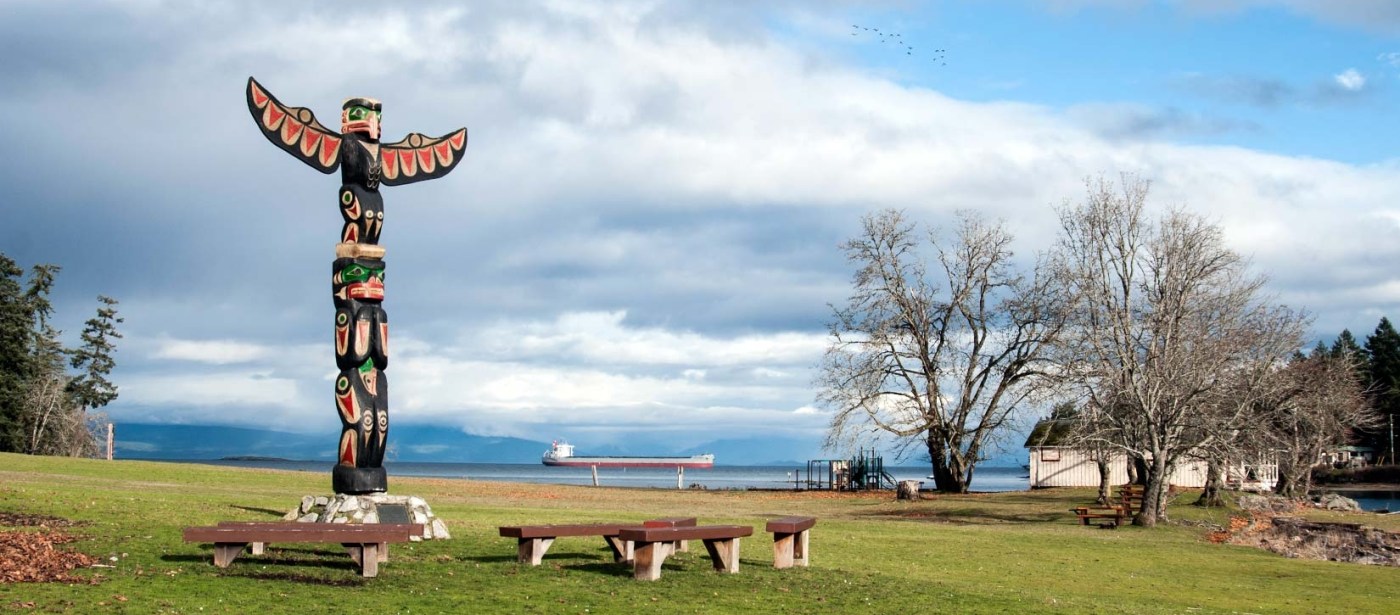
On my recent Air Canada flight from Montreal to Vancouver I was pleasantly surprised to view an acknowledgement made to Canada’s First Nation population interspersed with its safety instructions video. I might have felt astounded had it not been for sighting an earlier statement (now since removed) that I chanced upon on the Royal Victoria Yacht Club’s website recognising that its premises were situated on the territory that once belonged to the Songhees and Esquimalt Nations.
I have been a frequent visitor to Canada over the decades but this visit was the first in seven years. The aircraft that ferried me to my destination hosted four stewardesses, two of Chinese origin, one white Canadian and one native Indian. It would be foolish on my part to read too much into this observation but I left Canada realising that change is in the air not just politically but socially. Among the most visible changes are relations between mainstream Canadians and their indigenous counterparts.
The management of native Indian’s affairs is not just Canada’s but the Americas’ biggest unfinished business, from Canada to Chile. While visiting a farm in Victoria with my sister, the topic of immigration crept up conversationally and a white Canadian acquaintance of hers jokingly told her looking at me, “now that we are IN we have closed the doors behind us.” This statement, said in jest, perhaps self-deprecatingly, nevertheless opened a pandora’s box.
What if the native tribes of Canada were to have shut their doors to English and European immigrants that helped make Canada what it is today? This idea itself is unreal because indigenous communities never possessed the notion of doors as known to Western culture. Most of their dwellings had animal skins and woven reed mats at the entrance to regulate wind and stay warm.
Truth & Reconciliation Commission
The Government and people of Canada have been through a deeply introspective period in the last decade. Set up in 2008 under the administration of conservative Prime Minister Stephen Harper, Canada’s Truth & Reconciliation Commission’s (TRC) objective was to present the truth on historical incidents of mass murder, kidnapping and ill-treatment of native Canadian children in its residential schools. The Commission submitted its report in December 2015 during Prime Minster Justin Trudeau’s first term with what seems to have been an expanded scope.
I recollect having watched a bit of the live broadcast when the commission’s report was tabled in parliament back in 2015. It was accompanied by a strong apology and a total of 94 calls to action presented in two parts. The first was reparation to harms carried out historically and the second dealt with transforming prospective relationships with the Assembly of First Nations and Inuit people. These calls revolved around action items pertaining to education, health, child welfare, justice, language, incorporation of native Indian history in high school curricula and across the board reconciliation.
I had a long conversation with my nephew who was abreast with some of the current issues. He began by saying that there was a higher incidence of poverty, alcoholism and drug abuse among indigenous communities relative to other groups and he attributed this to their incomplete assimilation in Canada’s economic workforce. He said the move to restore some parcels of land to First Nation tribes had unleashed upheaval because people with legal land titles discovered their rights abrogated one fine day.
My nephew told me that another key outcome of the commission’s findings was to recognise and promote native Indian languages. There are as many as 12 different native languages and 70 dialects in Canada today. Many public infrastructure projects like bridges have had their names switched to native Indian ones. However, names in Indian languages being much longer than those in English or French have led to a struggle updating records.
Notwithstanding these challenges there has been progress in integrating indigenous people with the Canadian mainstream. Just how significant this progress is depends on who you are.
A Deeper Dive into Indigenous Culture
Not content with a single point of view, I undertook a bus ride to Whistler to visit the Squamish Lil’wat Cultural Centre. Just so you get an idea, the names of these First Nations would appear as Sḵwx̱wú7mesh and Lil̓wat7úl in native language. As part of my travel preparation, I was fortunate to have stumbled upon Indigenous Tourism BC website and signed up for a Talking Totems tour of Stanley Park, Vancouver offered by Talaysay Tours.
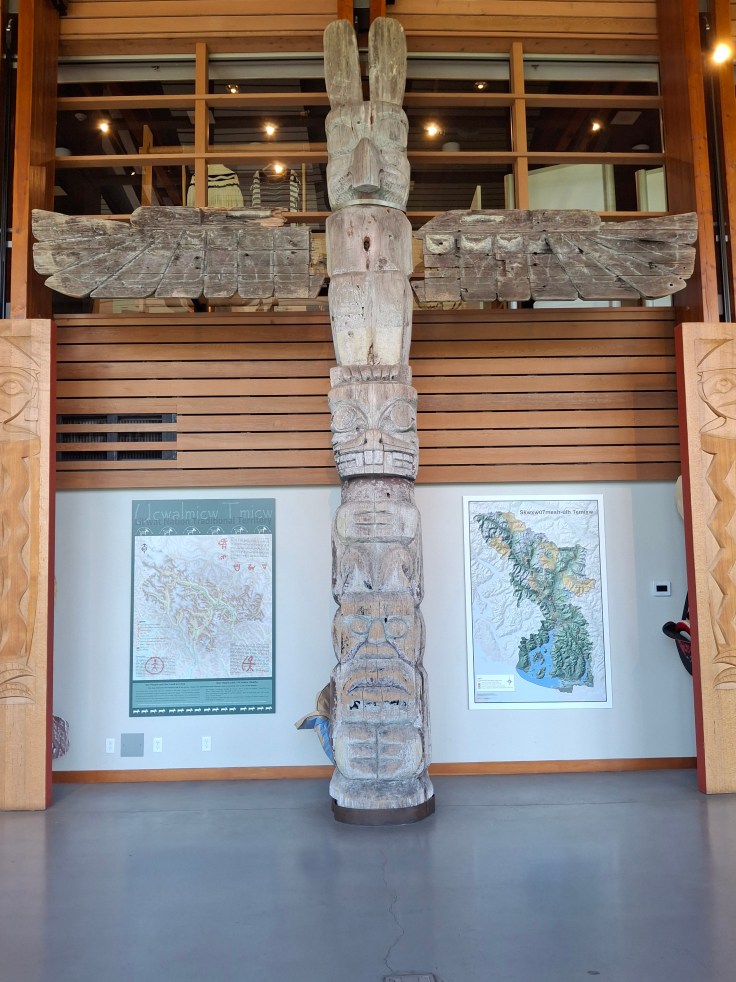
My visit to the Squamish Lil’wat Cultural Centre was an exposition of the cultures of these two Indian nations. It offered me a deeper insight into relations between themselves, their relations with Mother Nature, their art, craft and other traditions. Here I uncovered that once a totem pole is installed at a particular spot it is never moved till nature brings it down. However, the totem pole housed at this museum was once at the centre of a dispute and was thus shifted into the cultural centre.
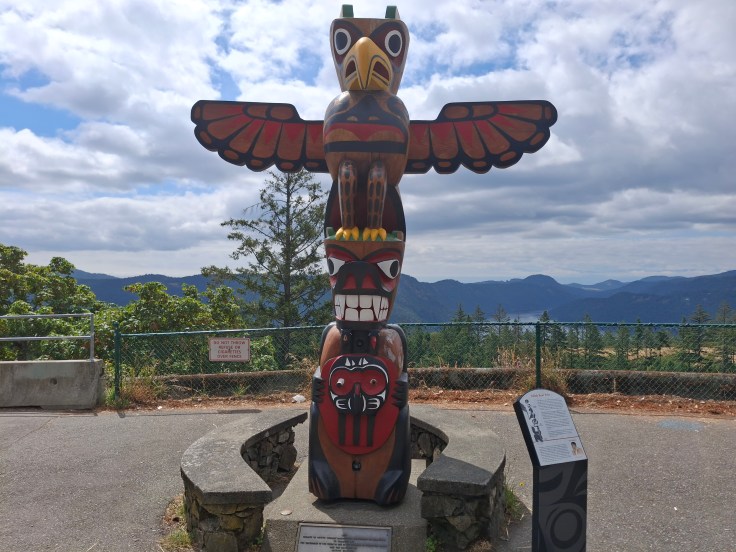
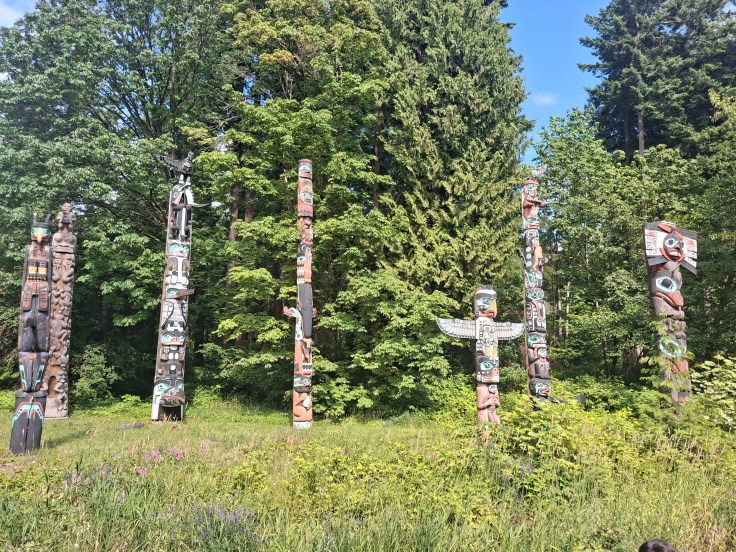
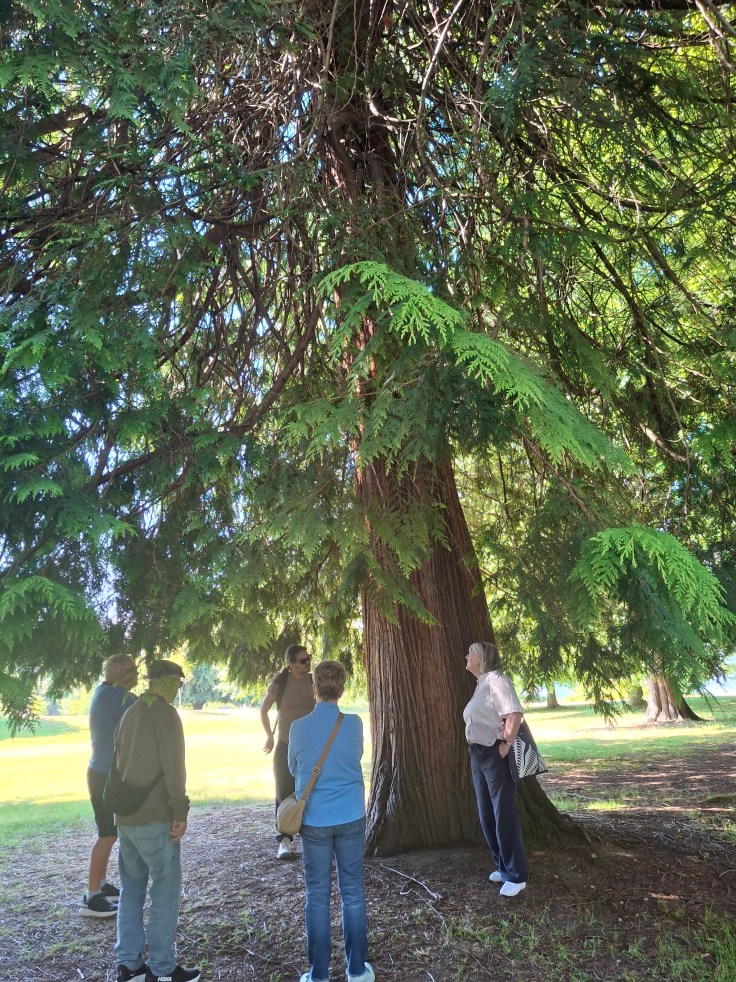
My walking tour of Talking Totems, in Stanley Park, Vancouver by contrast focussed on the deep relationship the people of the Salish and Northwest Coast hold with trees particularly the cedar. Led by Gavin, our guide, we heard several stories and accounts on how cedar bark is stripped and how totem poles are made. More interestingly he dwelt on the cultural protocols that are embedded in carved forms. The humpback whale and the mythical Thunderbird feature in many totem carvings. Gavin shared that there is a misconception that humpback whales are a killer variety and that over the centuries, humpbacks were known to be very helpful to fishermen lost at sea. He clarified that the recent incident of a humpback killing a female trainer was only because that whale had been born and brought up in captivity. Gavin belongs to the Haida Gwaii archipelago in Northern British Columbia and I had the opportunity to discuss many contemporary social issues.
Living in Harmony
Modern Law is a Western construct. For people from First Nations, law was established experientially arising from their deep kinship with nature. It should be noted that law as understood in modern adjudication attempts is a finite concept. It does not mirror the laws of the universe. Reconciliation based on Canadian law can therefore at best be half-way. Instead, what is needed is reconciliation rooted in universal values.
The idea of assimilation of native Indians into Canada’s economic mainstream as the final solution is fallible. The incidence of alcoholism and drug abuse amongst native Indians is more likely on account of the stark alternative of becoming lost in Canada’s mainstream. Even among themselves, First Nation tribes revel at being distinct from each other. Therefore, to be thrown into a melting pot of races might be the most difficult psychic barrier to overcome.
What if these reconciliation attempts were a two-way traffic? By this I mean, the Canadian mainstream looking at a comeback to Nature and an acceptance of some aspects of First Nation culture and traditions as their own. The redeeming part of Canada’s government and its people is that they are quick to apologise. However, my nephew pointed out that it doesn’t cost anything to place an acknowledgement in the public domain and there are many who see the latest initiative as a tick-mark exercise. Yet, in my recent travels I observed a heightened consciousness of repairing relations. To this extent, an acknowledgement serves as a modest starting point. Even if this jump doesn’t cover a lot of distance, it’s been a tall one and has the potential to amplify and become a carrier of unity. Which is why I refer to these recent developments as a Totem Pole-vault.
Feature image credit: Indigenous Tourism, BC
Shakti Saran is a systems thinker, writer, consultant, and the Founder of Shaktify, an initiative to power changemakers
Discover more from Shakti's Musings: Blogs on everything under the sun
Subscribe to get the latest posts sent to your email.
 Shakti's Musings: Blogs on everything under the sun
The incursion of the white Europeans, now 500 years ago, caused damage that highlights a lot of ills. Once we acknowledge this we can start to reconcile with the cultures of 12,000 years, then get on with re-learning what they’ve always known: that Gaia is our base, our support and our source of regeneration for another 12,000 years. We need to learn to listen as a start.
LikeLiked by 1 person
We have divided our society in so many different ways and this is just one other dimension. In India too, we have caste, religion, tribes, languages and the list goes on and the ability to assimilate all continues to detoriate. Swami Vivekananda’s emphasis on universal tolerance and the complete acceptance of all dimensions will always be relevant and civilizations that practice universal acceptance will prosper.
LikeLiked by 1 person