
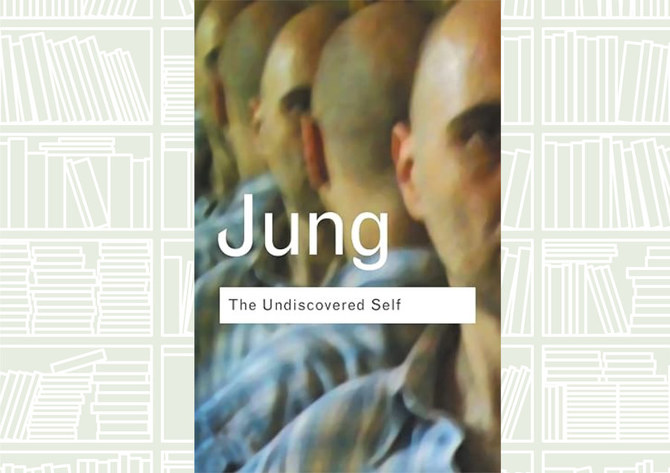
Carl Jung would have called it Synchronicity. I thought it was accidental. While researching on the subject of femininity and masculinity, I stumbled upon an insightful video recording by Salome Institute’s founder Satya Doyle Byock. Satya is all things Jungian and although I had heard of Carl Jung, the noted Swiss psychologist, from my college days, I was unfamiliar with his work.
This video watch on gender relations and archetypes was so intriguing that I signed up for Satya’s monthly talks. A highlight of my subscription was a slow read of Jung’s acclaimed book ‘The Undiscovered Self’. The book read was powerful and compelled me to convene my own book club reading of Jung’s book. Consequently, I ended up reading this book twice in a short span of time.
Written in the mid-50s, nearing the height of the cold-war, and first published in German in 1957 as ‘Present and Future’, this book translated in English by R.F.C. Hull is now universally known as The Undiscovered Self. It is a collection of seven related essays that dwell on the intersection of critical self-reflection, psychology, international relations, statehood, religion, philosophy, science and technology. Members of my book club found this book too dense, which it is, but just as diamonds are dense and need to be dug deep, so is the case with profound insight.
The book commences by depicting the plight of the individual in relation to modern society and the remaining essays extrapolate this theme. Reading this book was less of a discovery as much as it served as a validation of my own life long struggles to overcome mass-mindedness, seek true freedom and autonomy and quest for a spiritual existence unshackled from the dogma of organised religion.
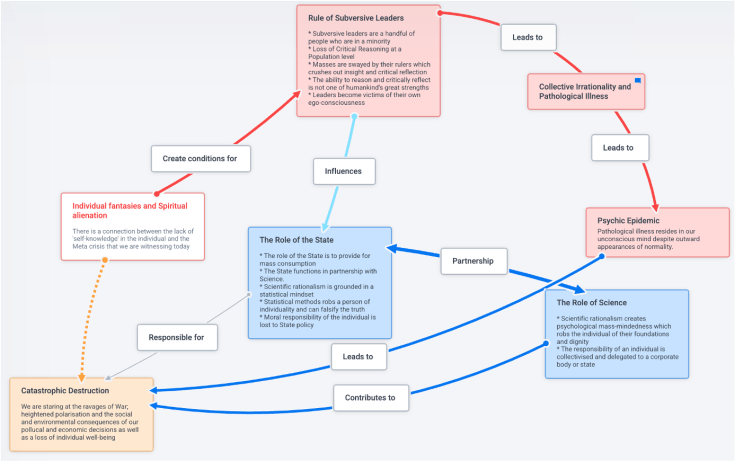
To view this mind-map in Plectica software, please click here
The Undiscovered Self is an invocation to self-discovery, the path to extrication from being caught between the statistical mindset of a state authority and the dogma of organised religion. Jung laments the political and psychic split in modern society which results in an amplifying feedback loop and he warns that so long as no bridge is found to overcome this chasm, the threat of universal destruction will always hang over us.
“What, then, has the West, with its political and denominational
schisms, to offer to modern man in his need? Nothing,
unfortunately, except a variety of paths all leading to one goal
which is practically indistinguishable from the Marxist ideal“
Essentially what Jung is telling us is that our shadow — our hidden fears, greed, desires and lust — do not remain private but instead contribute to a collective shadow referred to as the ‘collective unconscious’. The shadow is the source of our pathological illness and resides in our unconscious mind despite outward appearance of normalcy. The practice of psychology that ignores the unconscious ends up ignoring the pathological. But there is also a general fear of the unconscious and it is this fear that impedes self-knowledge.
Jung advocates individuation as distinct from individualism. Individuation is a process of looking inwards to explore one’s unconscious mind and integrate it with the conscious to free one’s self of our shadow whilst individualism serves the cravings and aversions of the ego and can be ruthless and destructive. Individuation is impeded when too much attention is given to our external environment. By recognising the darkness that resides within us we develop the capacity to overcome it and build human relationships sourced from unity. Jung says true change is unwilled and when our collective shadow starts getting reversed, we develop collective consciousness which is way more powerful than mass movements.
“The individual needs the evidence
of inner, transcendent experience which alone can protect
him from the otherwise inevitable submersion in the mass“
Carl Jung’s essays, written with sincerity have nevertheless attracted criticism. Although he was directionally right, Jung, a chain-smoker, was a victim of his own passions which he failed to fully overcome. Jung points us in the right destination but fails to show us how to get there. We obviously can’t see the back of our head directly. We need the help of a mirror. Quite similarly we can’t access our unconscious mind without some tool, method or praxis. How can we integrate our unconscious and conscious mind? Can individuation be realised only through therapy or can it be achieved without therapeutic aids? The author is silent on questions like these.
Jung was a sceptic of Western rationalism but by far, Jung’s greatest shortcoming lay in his own psychic split which he failed to conquer. For Jung, the ‘East’ meant the geographical region East of the Iron Curtain, popularly known as the East bloc. This has no semblance to the true East. Although Jung made two visits to India and wrote an introduction to a book on the Indian seer Ramana Maharishi, he is said to have got cold feet and avoided meeting him during his visits.
The fields of psychology and neuroscience have progressed dramatically since Jung’s passing away in June, 1961. Advancements in meta-cognition and human perception as a consequence of the work of Chilean scientists Humberto Maturana and Francisco Varela as well as others have stressed the nature of the embodied mind which is missing in Jung’s pursuit of self-knowledge. For instance, nowhere in Jung’s lexicon does the word ‘meditation’ appear.
In the 19th and 20th centuries, Europe was the epicentre in the discipline of psychology but It is a fallacy that it was the cradle of psychology. Psychological principles were well established in Ancient Asia. The Upanishads of ancient India dwelled on the individual in relation to the universe as potentially a Vishvakarma, an individual whose outer manifestation in nature reveals a multiplicity of forms and forces but sourced from an inner manifestation which exists in unity. Nevertheless, since we live in an era where Western science and rationalism are pervasive and the Western way of life predominates, we mustn’t lose sight that within these confines, Carl Jung’s book was ahead of his time.
Post script:
This blog was written and completed in Switzerland on June 6th, 2026 which I just discovered happens to be Carl Jung’s death anniversary. Would you call this synchronicity? Please feel free to leave a comment with your opinion. Thank you.
A member of my book club, David Cole wrote this extraordinary piece based on his review of The Undiscovered Self: The Polycrisis as Unresolved Individual and Collective Shadow
Shakti Saran is a systems thinker, writer, consultant, and the Founder of Shaktify, an initiative to power changemakers
Discover more from Shakti's Musings: Blogs on everything under the sun
Subscribe to get the latest posts sent to your email.


Leave a comment