
This is the third and concluding essay in the series, Of Sex, Gender and Archetypes on how the debate on sex and gender can give way to a more harmonious and equitable world.
“Since wars begin in the minds of men, it is in the minds of men that the defence of peace must be constructed.” — UNESCO Constitution
Introduction
In Part I we looked at how feminist movements have evolved significantly from the time of their genesis. We also noted the shift from feminism to humanism. But this doesn’t do away with the debate on sex and gender. In Part II we shared an understanding of the systems that cause oppression but these don’t reveal the root causes that give rise to them in the first place.
To read part I of this series, Females, Feminists and Feminism please click here
To read part II of this series, The Systems of Oppression please click here
A World Based on Feminist Foundations
Women’s International League for Peace and Freedom (WILPF), is a feminist outfit with a difference. Headquartered in Geneva and New York, WILPF champions gender rights; has been around for almost a century and has been associated with several feminist movements. They work relentlessly to address the structural, root causes of gender inequality. Yet, they strive towards peace and disarmament, ecological justice, feminist political economy and they work avowedly to mobilise men to achieve their goals.
Consider their vision:

The question that arises is: what are feminist foundations and who decides what is feminist and otherwise? Feminist foundations are principles associated with the feminine. To understand this better it is helpful to be conscious of language and table a few definitions.

The concept of foundations, principles, energies and archetypes associated with the feminine and masculine are found in diverse cultures world over and are variations of the same theme. Yin and Yang, a foundational pillar in Chinese philosophy, medicine and culture, signify polar opposite principles such as feminine and masculine, day and night et al. As the Yin and Yang black and white circle symbol signify, each side has at its core an element of the other (represented by small circles). Yin and Yang represent two opposite poles but their elements exist simultaneously and are not mutually exclusive. Neither pole is superior to the other and, as an increase in one brings a corresponding decrease in the other, a correct balance between the two poles must be reached in order to achieve harmony.
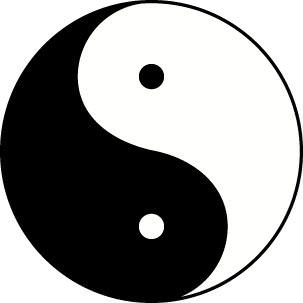
Image: Dan Carter on Flickr
The idea of feminine and masculine principles, as two opposite poles, surfaced in ancient India and is referred to in energy terms, i.e., Ida and Pingala, Shiva and Shakti. Renowned Swiss psychologist, the late Carl Gustav Jung proposed the idea of archetypes which he described as “a primitive mental image inherited from the earliest human ancestors, and supposed to be present in the collective unconscious.” From his experiments and his studies he derived the archetypes of femininity and masculinity which are distinct from both sex and gender.
When we look at the psychic make up of individuals, women, men and intersex, all are endowed with masculine and feminine qualities. According to Jung, embedded in the unconscious mind of every female is the animus or the masculine principle and every male has the anima or the feminine principle represented in his unconscious. Jung’s research and proclamations only served to confirm what sages in the East had for millennia espoused.
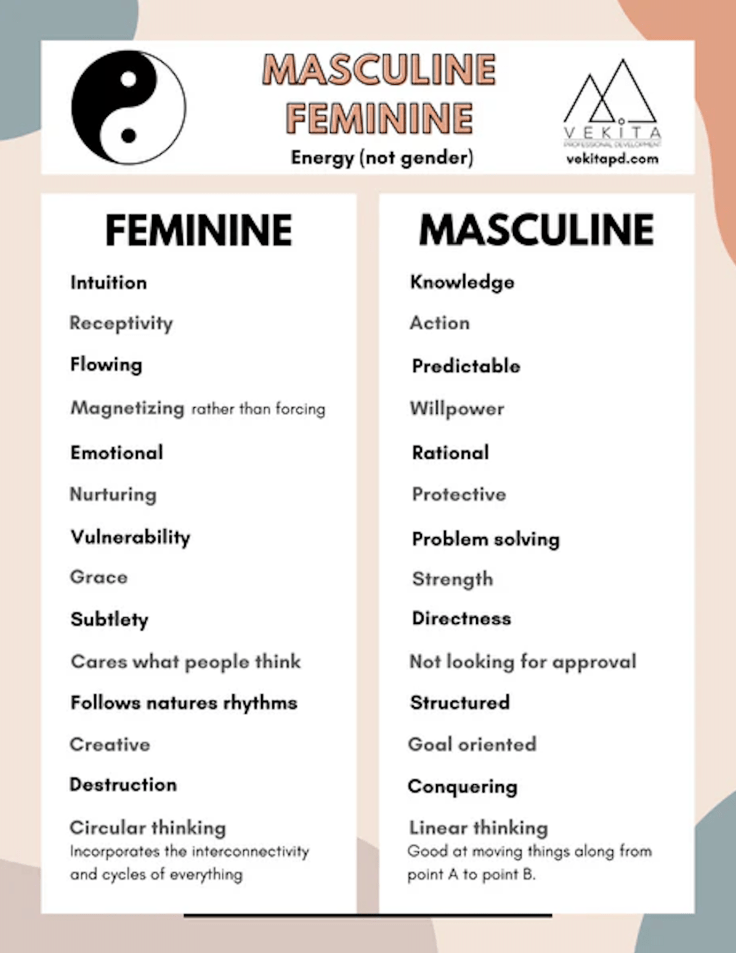
Image: Vekita Feminine and Masculine Workforce Dynamics
Underlying archetypes , energies or principles are a set of qualities. They are an adjacent space to values and it is qualities that help us ‘live our values’. The current debate on Sex and Gender has overshadowed discussion on principles and qualities. Biological sex manifests at a gross, physical level and while gender is subtler, qualities and archetypes reside at the subtlest level. For example, a cisgender, heterosexual male may have a set of qualities associated with the feminine such as being empathetic, nurturing and caring. It is a lie when people say that men don’t cry. It should be noted that archetypes do not connote stereotypes. The former refers to an idealistic behaviour pattern possessing a universal quality while a stereotype is a reductionistic oversimplification that can be dehumanising.
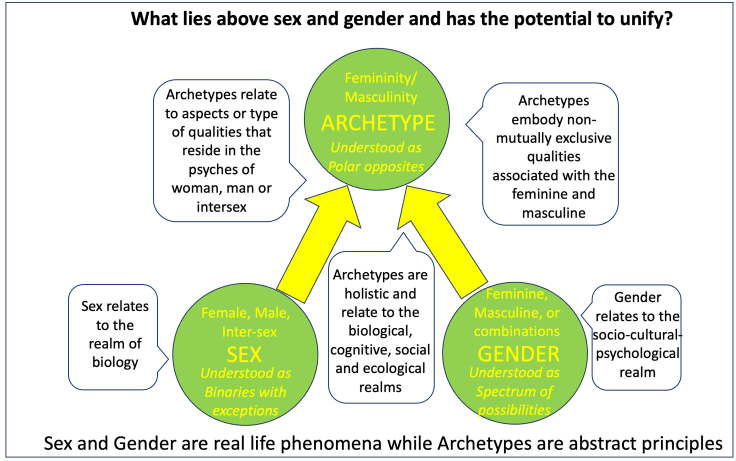
The current debate on Sex and Gender has overshadowed discussions on Principles and Archetypes
How Principles Manifest
An example of how principles of femininity and masculinity shape our daily lives lies in our ways of knowing. Our education systems are overwhelmingly influenced by the pursuit of explicit — as opposed to tacit — knowledge and by the lop-sided use of our left-brain. In Jungian terms our education systems are largely a product of the archetype of masculinity.
Explicit knowledge is clear and has boundaries. Tacit knowledge arises from embodiment and experience and is without boundaries. Digital technologies are disembodying because coding is based on what is explicit. But this doesn’t mean that algorithmic knowledge needs to be abandoned. We need both. Digital ways of knowing need to be brought into balance with feminine ways of learning. In short, we need to bring our left and right brain into balance.
Author Nicole Serena Silver captures the essence of femininity beautifully when she writes, “Part of the issue in the past has been that women in business stepped into a man’s world and felt they needed to be more masculine to succeed. This disconnect made for unhealthy interactions and internal discord… women can be just as fierce without having to be something they are not. You can set boundaries, garner authority, and embody confidence without compromising your femininity.” The only blind spot in Nicole Silver’s essay is that femininity doesn’t belong exclusively to women. Femininity and masculinity are embedded in every human regardless of sex and gender.
Just as gender is independent of sex, archetypes while being related are independent of sex as well as gender. To take my own example, my name is Shakti and it stands for the power of the feminine and I have imbibed feminine qualities to bring them into balance with my masculinity. The feminine and masculine in me plays out differently in varying degrees depending on space and time but overall they remain in a state of balance whilst my identity remains that of a cisgender, straight male.
The Future of Feminism
It cannot be understated that none of us are wholly female or male. There is no such thing as an absolute woman or an absolute man. Biology teaches us that we are apart at the surface but not at our core. We are composites of each other, albeit in varying degrees. All individuals possess varying levels of estrogen, testosterone, and progesterone, the hormones that lead to sex expression. Yet, at the level of biology duality is very apparent. It takes a spermatozoa to fertilise an egg and there is nothing in between. The building blocks of a human consist of just two chromosomes, X and Y and it is their different combinations that lead to sex expression even in the case of intersex people. There is no third chromosome.
When we move to the realm of gender, here again we are partial reflections of each other. In fact, it was the feminist queer movement that demonstrated that gender is fluid and not necessarily related to sex assigned at birth. The limitation of the gender discourse however, is that to distinguish male and female behavioural characteristics, advocates look at one’s dressing style, facial expressions, body movements and manner of speech. But are these the only attributes that bring out the feminine and masculine in a person?
In the context of feminism, while there is truth that behavioural traits such as cognition, language and level of aggression are influenced by our hormones, we need to revisit what superiority really means. Like for like, in any Olympics 100 metre dash men have always been faster than women. But does that really make them superior?
“Feminism isn’t about making women stronger. Women are already strong, it’s about changing the way the world perceives that strength.”
G.D. Anderson
Women’s movements need to breakout of their self-imposed limitations of equality for equality sake and treat sex, sexuality and sexual orientation as necessary but not sufficient. Going forward, feminism needs to search for balance and embrace a wider set of universal values such as compassion, humility and loving kindness.
If the gender discourse shuns binaries, why have classification at all? Whether it’s two or three or fifty-eight, why divide humanity? The redeeming feature of Yin and Yang, of feminine and masculine energies and principles are they serve as a continuum with infinite possible combinations.
Denying that duality exists doesn’t help us transcend duality. Monica Sharma, a pro-activist and author of Radical Transformation Leadership summarises this neatly, “Phenomena in the dual world are interdependent and related through cause and effect. The world operates largely in a dualistic manner with many polarities. The complex problems we currently deal with… are based upon exclusionary cultural human behaviours. They cannot be resolved by the linear reductionist thinking that created them in the first place.”
Archetypes aren’t the final destination but in this debate they take us to higher ground.
Epilogue
A lesson for us to learn is that the laws of social structures may have some similarities with, but are not identical to those of biological structures. To imagine we can superimpose one set on another is foolhardy. An insight that we can borrow from the domain of economics is that while communism was founded on the ideal of equality, at the root of our biological existence, this is an impossibility. Though the single cell bacteria may lack a biological sex, the fundamental building blocks of matter and mind are conceived on opposites. The universe is everchanging and fluid but is a proponent of complementary opposites: protons and neutrons, waves and particles, tacit and explicit, femininity and masculinity. Whether we look at dancing with opposites or transcending duality, by means of whatever language, each one of us has the potential to achieve oneness.
*****
Shakti Saran is a systems thinker, writer, consultant, and the Founder of Shaktify, an initiative to power changemakers
Shakti would like to thank Dr Hélène Liu, Paramita Banerjee, and Sudarshan Rodriguez, for their reviews and precious feedback. He does not claim that any of the three would necessarily endorse everything that is presented in these essays
Feature image credit: Ross Edwards
Discover more from Shakti's Musings: Blogs on everything under the sun
Subscribe to get the latest posts sent to your email.
 Shakti's Musings: Blogs on everything under the sun
Somehow I must have missed essay #1 and #2, but all three together are very insightful.
Thanks for putting it together, Shakti!
LikeLiked by 1 person
Thank you Ulrich. Glad you found it meaningful. Links for the remaining two essays appear in every essay.
LikeLike
., Ida and Pingala, Shiva and Shakti
are incomparable shiva and shakti are from the conception that holds consciousness as an ontological primary.
While ida and pingala are physiological processes the synthesis of which unleashes the sushumna or the energy potential latent in this body we have
There are way more issues 😕 in this synthesis that confound the issue at hand, but if the intention as stated was to have a healthy discussion just on the top of the above two positions from the Indian episteme/ yoga conception. If one must step forward and reach moksha the best possible way needs a curation of rituals that enable the process and that is what creates the beliefs and emergent structures in the culture.
LikeLike
Thank you. The purpose of bringing contrasting opposites out is only to say that duality exists in our physical, material universe. We can transcend duality but we cannot deny its existence.
LikeLike