

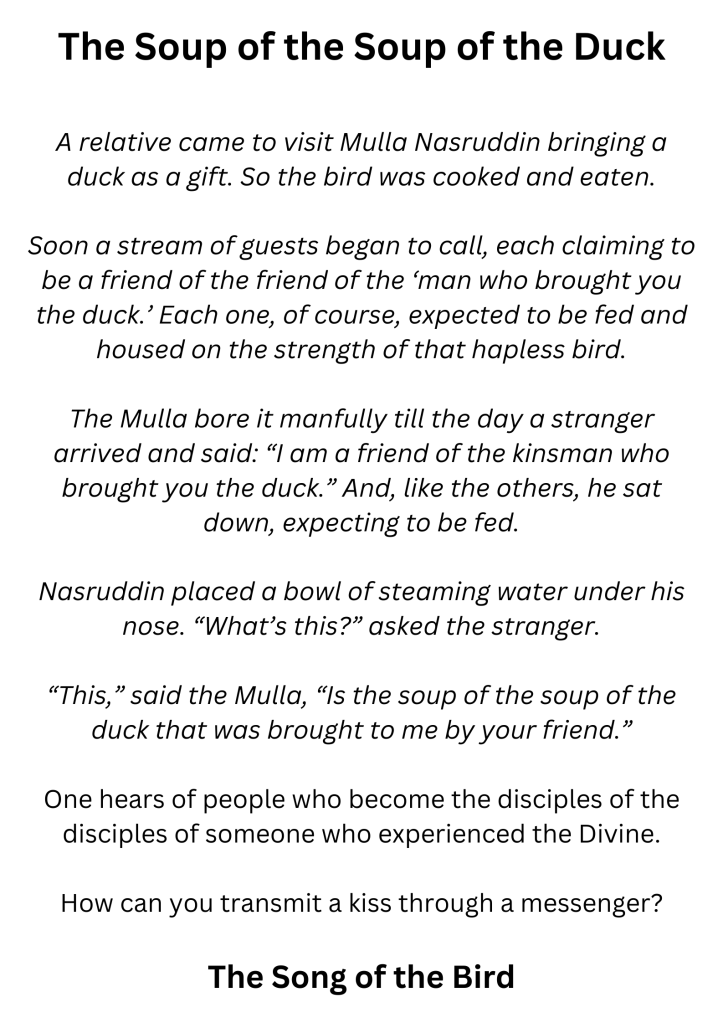
The Master gave his teaching in parables and stories which his disciples listened to with pleasure — and occasional frustration, for they longed for something deeper.
The Master was unmoved. To all their objections he would say, “You have yet to understand my dears, that the shortest distance between a human being and Truth is a story.”
Another time he said, “Do not despise the story. A lost gold coin is found by means of a penny candle; the deepest truth is found by means of a simple story.” — Anthony de Mello, S.J., One Minute Wisdom
My tryst with Father Anthony de Mello, S.J., affectionately known as Tony, started a few months after his untimely death in June 1987. I was with my brother-in-law and I happened to chance upon a book ‘One Minute Wisdom’ compiled by Tony. When my brother-in-law saw my face light-up he said I could keep it. This was the start of my spiritual journey.
The truth about all realms related to spirituality, be they religion, philosophy or theology, is that they can be devoured and understood only by a micro percentage of humanity. Although Tony was a Jesuit, and one among a minority who ended up taking the fourth vow, he used storytelling in ways that spirituality could be made accessible without sermons and studies. His work remains unprecedented for anyone who belonged to the Catholic Church.

Of Stories and Storytelling
A story is a tool to achieve a purpose that series of intellectual discourses cannot match up to. Great beings like Buddha and Jesus leveraged stories to get their messages across. They did so because a story has the inherent capability of being undetected by one’s defences. As Tony put it so beautifully, “The story will worm itself into your heart and break down barriers to the divine.” Essentially, a story helps because it provides a sugar coating to swallow the bitter pill called Truth.
Tony’s genius resided in building a massive collection of fables, tales and anecdotes, which he could retrieve and present at will anytime, anywhere. The beauty of these stories is that they hailed from a diverse set of socio-cultural and religious backgrounds. The Master, a figure who appears in several of Tony’s works would change personas very frequently. The Master could be a Hindu guru one moment and a Jewish rabbi, Christian monk, Sufi mystic, Taoist sage or a Zen Roshi the very next moment.
By his own admission, Tony never invented stories. He strung them together in ways that were aligned with domains such as prayer, awareness, religion, grace, love, ego, truth, education, service, relationships et al. The beauty of his story-telling resided in ensuring his tales were not more than three or four paragraphs and each tale could be read in under a minute. It was his brevity that powered them.
His life and mission
Born in 1931 in what was then Bombay, Tony in his formative years and much against his parents’ wishes, chose priesthood with the Catholic church. This requires taking vows of Poverty, Chastity and Obedience. Tony began his Jesuit journey with an extremely orthodox disposition, was ordained a priest in 1961 and took his final vows at Rome (the fourth vow) in 1965.
His ordainment more or less coincided with Vatican II, a Vatican-led transformation of the Roman Catholic church. It was in the late ‘60s and early ‘70s that Tony renounced his orthodoxy to embrace Eastern philosophy and dedicated his life to a quest for a universal Truth to unify people of all faiths and creeds, even atheists and agnostics. He did his best to integrate his work to be compatible with the teachings of the Church to whom he avowedly remained loyal till his last breath.
During this tumultuous transition Tony expanded his horizons to learn more about psychotherapy including Gestalt Therapy and weave them in his work. He also took to Vipassana meditation and organised 10-day retreats for Jesuits by the legendary S.N. Goenka. In Tony’s biography, ‘The Happy Wanderer — A Tribute to My Brother’, Bill de Mello writes, “With Tony’s brains, it could be very normal that he would be picked up to be a professor, normally of theology. But according to me, this was not meant to be. It was not the path in which Tony would bring about all that was in him, and that would come with the Spiritual renovation of the Church and Christians.”
The controversy
Tony’s story is a story of evolution. An evolution from orthodoxy to flexibility and from single-mindedness to becoming all-encompassing. Despite the reformation brought about by Vatican II, his work was seen by some as being heretical. His Sadhana retreats started facing objections from the Vatican because these incorporated unorthodox and unconventional methods.
After his death, in June of 1998, the Vatican under Pontiff John Paul II, issued a notification concerning the writings of Father Anthony de Mello. What started off as a ban on his books was retracted into an appreciative inquiry along with a disclaimer regarding his writings. The Church’s viewpoint was that his positions were incompatible with the Catholic faith. This despite all his publications having the Imprimatur of a Bishop and in some cases the Imprimi Protest of the Provincial.
Anthony de Mello has been more celebrated after his death than when he was alive. He left a legacy that few can rival. To his credit, he brought matters that were only in the grasp of specialists to the reach of non-specialists. He went about reforming himself and through his actions, the communities and the Church to where he belonged. He achieved what he had to not through radical action, nor through activism but through the medium of a story, a device that was in reality, as deceptively simple as it was complete.
Feature image credit: exploringyourmind.com
Shakti Saran is a systems thinker, writer, consultant, and the Founder of Shaktify, an initiative to power changemakers
Discover more from Shakti's Musings: Blogs on everything under the sun
Subscribe to get the latest posts sent to your email.
 Shakti's Musings: Blogs on everything under the sun
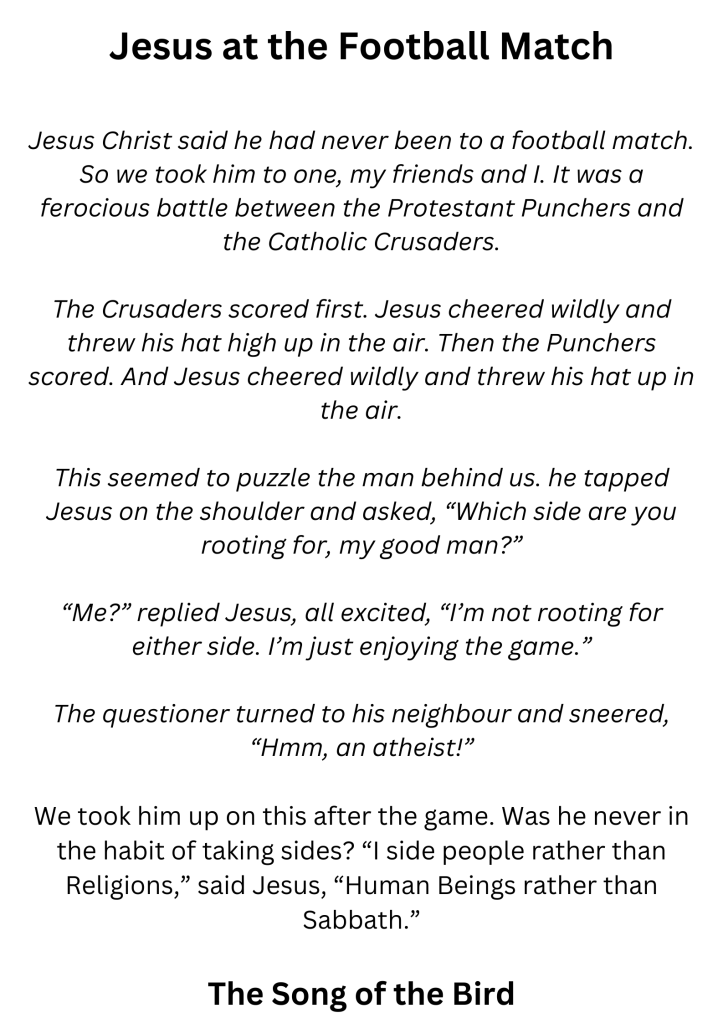
Jesus at the football game—I was remarking to a friend last week that so many of the professional ball players (football, baseball, especially), bang their fist on their chest and kiss their fingers, then point with one or two fingers to the sky, thanking God for their touchdown, their three-run homer, etc. I always wondered how that worked in the mind of the athlete: grateful and adoring if you were winning, but hateful and resentful if you were not? How was it that Black, White, Hispanic all shared God’s favor in a ball game when 10,000 people were watching but not once they got to the parking lot alone?
The second half of the discussion revolves around the fact that a professional ball player now makes $1M/week—the same amount that my wife and I earned in 100 years of work combined. We looked up concert tickets to see Beyonce (with absolutely no intention of going) to find that the better seats were $13,000. I was in Buffalo, NY, a few years back and turned down taking 4 friends to a comedy show for $230 each. This is capitalism at its zenith and competition and greed are signs of a very wrong direction for our species. I will keep in touch to get your help to figure out how to change this in my sphere of influence.
Hope you are well, Shakti, and remain so for long years to come.
Mk
LikeLiked by 1 person
Thank you Mark for your kind sentiments and for capturing this reality. Well, for most people, across cultures, God is a conduit for ‘receiving’. It is a much smaller minority that seeks God to be able to give.
LikeLiked by 1 person
Shakti Saran, thank you for your time and efforts to share this. “Awareness” was recommended to me by a friend some years ago, and I have never been the same since….thankfully!
Would love to know about any others like Tony, who are writing, or whose books are available. I reread Tony’s books often and still get new wisdom each time. Grateful for Bill’s work in keeping the messages available daily.
In gratitude 🙏
LikeLiked by 1 person
Thank you Craig. I am glad you enjoyed this piece. When it comes to storytelling, there is no one I have come across who can match Tony’s work.
Specifically, on ‘Awareness’ there is another wonderful book by the same name authored by Osho. The latter makes an equally good read.
LikeLike
I will order it today. Thank you for the recommendation. I live in Mexico, muchas gracias 🙏
LikeLike
Dear Shakti,
First of all, thank you so much for sharing this with me!
I had heard of Anthony De Mello, but I admit that I didn-t know much about him or his writing. Your blog has sparked my curiosity…
Undoubtedly, these short, bite-sized stories are pearls of wisdom…helpful and valuable to all who search for meaning and understanding. Just as relevant now as ever.
As you know, I am attempting to find ways to deepen and connect diverse ways of learning – through art, languages and movement – that is simpler, yet more layered and hopefully more meaningful, so this discussion has inspired me a lot!
So much food for thought!
Once again, thankyou for your generosity.
LikeLiked by 1 person
Thank you Angela. Am glad you enjoyed this piece. You’ve hit the nail on the head by stating that learning methods need to be diverse. I cannot agree more with you. Although my blog is on storytelling, the role of experiential learning is significant. I wish you well in making learning accessible to a wider audience. Keep up the great work you are doing!
LikeLike