
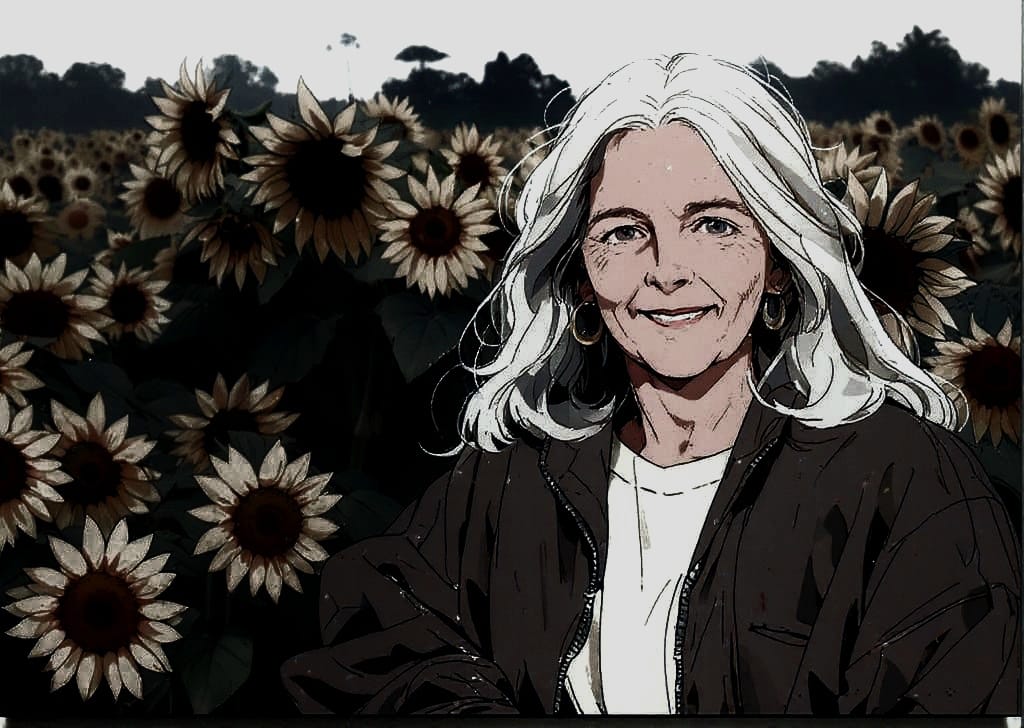
It is the third week of September 2025. Mumbai has a special visitor in Helena Norberg Hodge and I’m on my way to hear her speak at Don Bosco School, Mumbai. Google Maps tells me I have zero buffer to get there and I keep my fingers crossed. As luck would have it, I run into a Durga puja procession on the way and my apprehensions are confirmed. I am stuck in a severe traffic snarl and end up entering her session almost half way through.
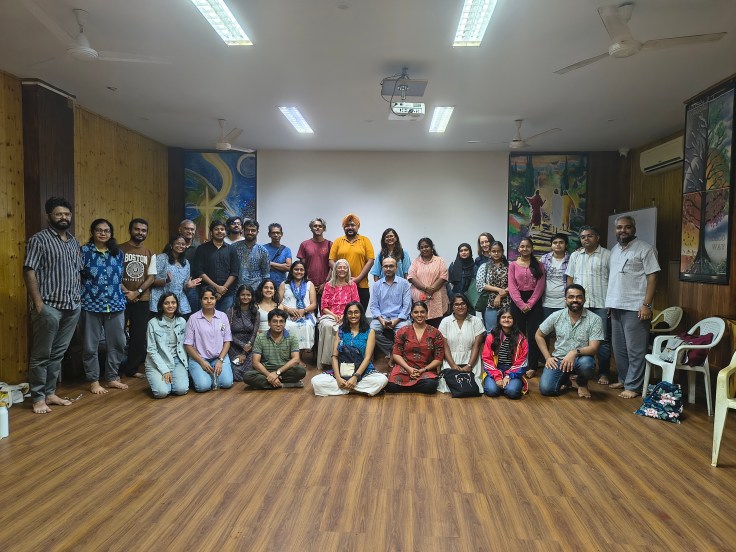
I enter the classroom with an apologetic look on my face but am unable to convey an apology because of the animated conversation that’s going on. I observe: without exception everyone has removed their footwear before entering the classroom and most people are squatted on the floor transfixed and listening to what this lady has to share.
This is Helena’s first visit to Mumbai. She is addressing a civil society gathering at the invitation of Blue Ribbon Movement (BRM). I associate Helena with nature and regeneration so I am at first a bit surprised she is here in this concrete jungle. But there are good reasons to visit Mumbai. One, she has a fan following here and two, the residents of this megapolis have an imperative to listen to her.
The event gets over and I get up to have a private word with her. I tell her that I heard about her work through Fritjof Capra whose student I am and that last year I did a webinar with her associate, Morag Gamble, on Food Systems. “You must be knowing Morag and Fritjof?”, I ask. And she replies in the affirmative, “Morag lives not very far from me (Australia’s East coast) and Fritjof is a good friend but I haven’t seen him in a while.”
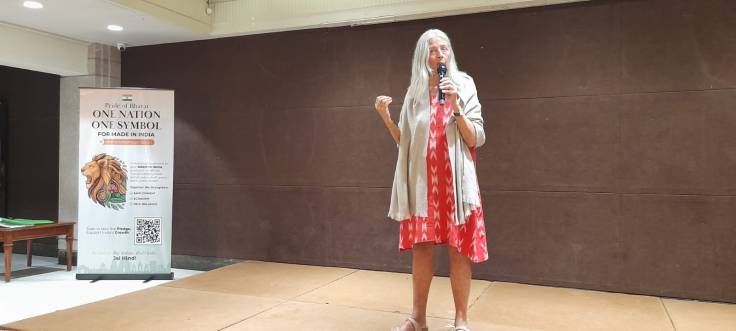
Despite missing the first half of this conversation, I have reasons to be hopeful. Anjali Tripathi of BRM announces that recordings will be made available and Helena is going to address another civil society gathering in Mumbai that evening with similar if not identical messages. I accompany Anjali to Vinay Somani’s ‘Social Change’ town-hall.
About Helena
An Australian national and Swedish by descent, Helena visited Ladakh, in Northern India, in 1975 as a part of a film crew. So struck was she by the quality of life that it dramatically altered her world views. A natural linguist who was well versed in as many as six languages, Helena was amongst the first Westerners to learn Ladakhi, the local language. Along with her husband she initiated the Ladakh Project in 1978, a forerunner to what was eventually to become Local Futures, a movement to promote localisation, globally. The two talks she delivered in Mumbai dwelt on her learnings from Ladakh and what these meant for the rest of the world. Helena is the author of Ancient Futures and Economics of Happiness.
Key Takeaways
Life in Ladakh
Helena’s encounter with the people of Ladakh was surreal. The people of Ladakh were Joyous and happy; collaborative in relationships and with a seamless sense of connection between oldest and youngest. They didn’t know what depression meant. In that era and prior the incidence of suicide was virtually non-existent and maybe one case in a generation. A once self-contained society, 15 years later opened its doors to the global consumer monoculture. With it has come depression and even suicide, the incidence of which is now more than one a month.

Picture credit: Local Futures
Localisation as a Counterbalance to Globalisation
The global capitalist system has destroyed Ladakh’s and other local cultures extensively. Global monoculture does not respect the primary fact of life that nature values diversity. Globalisation, inorganic farming and the rampant global food-trade are leading to climate change and increasing levels of toxicity in our environment. The need of the hour is to build and strengthen localisation movements, globally. The competition, the fear of not being perfect, of not being beautiful enough and the belief that other countries are better is false. Local Futures offers toolkits and resources to protect communities against the consequences of global industrialisation. She cautions, however, that localisation shouldn’t lead to isolationism and we mustn’t lose sight of the larger, global picture.
“I really think we can have a very powerful movement very quickly once we go beyond the local thinking. We mustn’t think too locally. We’ve got to think globally to understand why everyone benefits from localisation“
Science for Profit
Science for Profit became so evident in the pandemic.
The dominant global monoculture is divisive, competitive, speedy and increasingly drifting towards inhuman, techno-robot-based and algorithms-based economy. AI in the service of that system is going to be monstrous. That AI will help us diagnose cancer earlier was what was said with genetic engineering as well. The truth is that the dominant cause of cancer is not related to genetics. It has got to do with lifestyle, the harmful foods we eat and the products we consume and are exposed to. This includes pesticides, herbicides, fungicides and plastic.
Algorithms treat us all like the numbers that don’t see our humanity, don’t recognize what it means to lose one’s language, roots and connections with one another. This phenomenon is life-destroying, and certainly not supportive of democracy or health.
We need to leverage technology to communicate the big picture and we need to do it quickly
Picture credit: Anjali Tripathi, Blue Ribbon Movement
Mental Health in the West
One of the things young people in Mumbai need to know is that in America and Sweden, mental illness, depression, suicide, addiction is much worse than here. They need to completely rethink their idea that the West is superior. They need to understand real wealth as health, physical and mental. In the West, people are so lonely and so cut off. Even though the incidence of depression is growing here, it’s much worse in the more industrialised countries. In Sweden, where she grew up, more than half of every dwelling in Stockholm is one person living alone. And they have a lot of depression, suicide, alcoholism. But this news doesn’t travel. We need to make clear that such a mental health crisis as is the case in the West, we cannot possibly call that wealth.
Picture Credit: Vinay Somani, Social Change
Educating Girls in Relation to the Feminine
Educating girls is an imperative but begs the question ‘what kind of education’? Contemporary education has been tailor-made to suit globalisation. A conventional curriculum will not work. A values-based education needs to be imparted to women because women are faster learners and are the carriers of wisdom
And so there is a way that the future needs to be more feminine, the future needs to bemore local, and I’m calling that also an ancient future. So, we have to be very careful when the UN tells us about schooling, they’re not regaining the feminine.
Commentary
Helena’s talks were a gust of fresh air. Very inspiring is how I would describe my encounter. However, let’s face it…we cannot wish away the New York Stock Exchange. The global capitalist economy is not a switch. But her response to this is “Now, we may still support it (the global capitalist economy), but at least we’ll be aware and we’ll talk about how we have to make a compromise. We can’t be 100% pure. We’re not going to be localised overnight. We’re going to end up buying things from these big businesses.”
That we have gone so far in globalisation, this is staring at us in the face. The new generation of AI tools are rapidly pushing us to the edge; an extreme from which we can only rebound. The latter may just be a blessing in disguise.
The key point here is that what needs correction is the imbalance between globalisation and localisation and the imbalance between science-for-profit and science that is not-for-profit. There are benefits to globalisation that we cannot ignore. The very airplane that brought Helena to Mumbai from Ladakh is an epitome of global capitalism. Do we want to go back to the era where we only cross the oceans in steamers? The foremost question to ask in the AI era is whether we want to be enslaved by technology or do we see a role of humans to remain masters? We cannot throw the baby with the bathwater.
In my career spanning over four decades, I have seen both the negative and positive sides of business and have first-hand experienced that science can lend itself to not-for-profit. At IBM which was my last corporate sector employer, I was deputed to Morocco for a one-month social sabbatical to help the Government of Morocco and Moroccan non-profit organisations with zero strings attached. On retiring from IBM, I enrolled in a leadership program at India Leaders for Social Sector that is designed primarily to support corporate sector employees transitioning to the non-profit sector. Later, at Pyxera Global, I supported corporate sector teams to work pro bono on projects in the impact sector. Science-for-profit is the outcome of an education system that glorifies greed. It is not an inherent defect of science itself.
Yet, I must bow down to Helena for her astounding courage, her humility and her graciousness and although going forward the rest of the globe will very unlikely remind us of what Ladakh was in the mid ‘70s and prior, her courage and conviction can at least help us get centered. Thank you, Helena Norberg Hodge 🙏🏼
Shakti Saran is a systems thinker, writer, consultant, and the Founder of Shaktify, an initiative to power changemakers
 Shakti's Musings: Blogs on everything under the sun
A great insight to see how a culture that was a happy ,content one changed with the exposure of the outside world.
Very sad to see how depression has played a role and role it plays globally . Always to be better , no that has to change. Be ourselves , be content, maintain a healthy life and balanced mental health.
Thank you Shakti ,I really enjoyed this read .
LikeLiked by 1 person