
It may seem odd if not heretical for an avowed systems thinker to write on this topic. The truth is that linearity is indispensable in our day to day living and in situations it may even be desirable.
Over the last hundred years systems science has progressed considerably and in the new millennium, it is steadily building inroads into the mindspace of its linear science cousin whose presence has dominated for almost four centuries. Systems thinking is a body of knowledge that can save us from devastation and oblivion and can help us activate the natural homeostasis in our individual lives, our communities and our planet.
Yet linearity cannot be ignored. Targeting linearity should not become our new-found bigotry. This piece is an elaboration on why I feel this way.
Everyone who is reading this blog is in some way or the other a beneficiary of an industrial civilisation regardless of whether or not one has the aptitude to think linearly or otherwise. Whether it is the light bulb that an artist uses to spotlight her work or the usage of Zoom by a community to get together, all of us are products of an industrial society that has been built on linear foundations.
To oppose linearity is akin to inviting airplanes to simply fall from the sky or bridges to collapse. It is as perilous as Don Quixote fighting the windmills, a delusion that every now and then creeps in during discussions on this topic. Lets’ face it: industrialisation and its mechanistic accompaniments are here to stay. If it wasn’t for the advent of high-speed computing — which has its roots in binary logic — Edward Lorenz would never have discovered Chaos Theory, one of the key pillars of Complexity Science.
As a student of Fritjof Capra’s Capra Course — an advanced systems thinking program — I was struck by his opening remark that his course, designed to instil non-linearity, unfolds in a linear fashion. It is true that if his course was designed like a shuffled Spotify playlist, it would have most students banging their heads against a wall in exasperation.
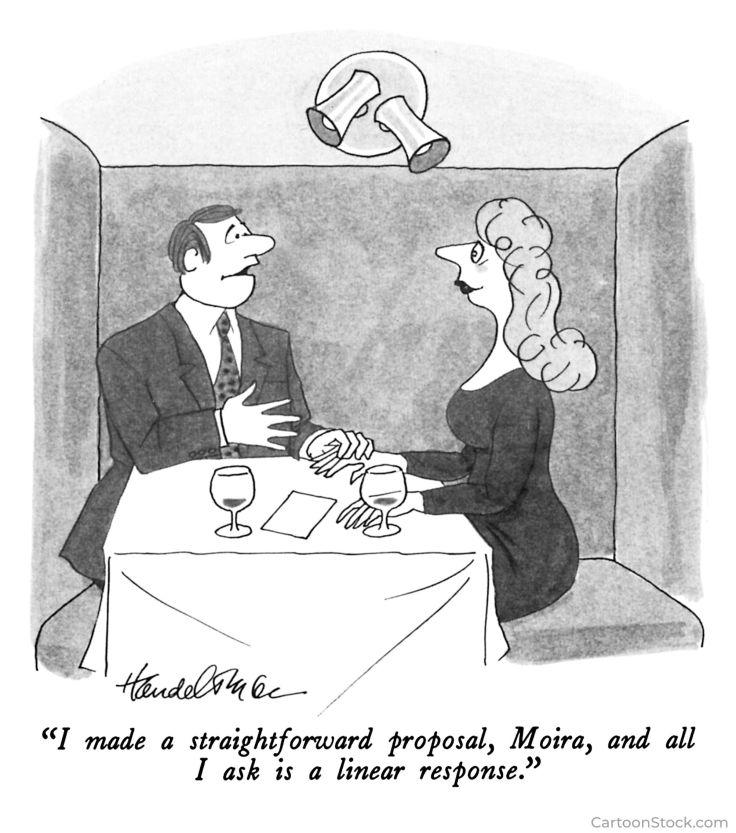
Non-linearity is not always sacrosanct. Let us not forget that it is a non-linear and convoluted mindset that crooks of the world capitalise on. Everything that Science has discovered and produced can be used in positive or negative ways. Quite similarly non-linearity doesn’t guarantee an enlightened outcome.
The central challenge today is not linearity per se. It is our extreme over-reliance on linear thinking and our left-brain that is the source of our individual and planetary woes. To imagine that linearity alone has the answers to all our questions and hopes is like playing the game of life on a billiards table constrained by an artificial boundary in an ever-expanding universe. It is our being enslaved to linearity that is the root cause of our misery.
The current tariff war that POTUS has unleashed on the rest of the world stems from the realisation that United States has deindustrialised itself in its single-minded chase for corporate profits. The globally integrated enterprise is a confirmation of the troubling linear mindset that Wall Street suffers from because when business enterprises think of profits to the exclusion of everything else, it becomes an invitation for an uprising of a different kind. The current dispensation of the American administration to course correct is a desperate attempt to force-fit an alternative linear solution for something gone so awry. This unfortunately is akin to building a Tower of Babel, destined to come crashing down.
In his books Sadhana: The Realisation of Life and Personality, India’s national poet, Rabindranath Tagore, extolled the realisation of the ‘infinite’ in reconciliation with the ‘finite’. Using the allegory of a river that seeks its course to its destination, the ocean, the poet alludes that should a river run amuck it has no hope of merging with the relative infinitude of the ocean. Instead, a river learns to live within the finitude of its embankments steadily inching towards the infinite.
For Tagore, the realisation of the infinite is the discovery of the oneness that prevails in the universe which essentially is a non-linear state of mind. The finite on the other hand represents the world of necessity, food, clothing, material possessions and pleasure and is the world of narrow limits and linearity. It is the finite or linearity that is a segway for the non-linear infinite.
What is clear is that unless you are born to live the life of a monk, linearity cannot be eschewed. But it can be tamed and used as a tool. It is the pursuit of this tightly-coupled, sacred partnership of linearity and non-linear thinking that will eventually liberate us and ensure regeneration in our beloved planet. As paradoxical as it may sound, linear means can help us come in contact with an infinite and non-linear reality.
Shakti Saran is a systems thinker, writer, consultant, and the Founder of Shaktify, an initiative to power changemakers
Feature image credits: Sarah Firouzabadi Unsplash
Discover more from Shakti's Musings: Blogs on everything under the sun
Subscribe to get the latest posts sent to your email.
 Shakti's Musings: Blogs on everything under the sun
Your cosmic timing for this article could not have been better: I had been questioning almost all of my ‘tools of social change’ as being linear, not systemic, and therefore not ‘right’ or useful. And so it is that you pointed out that even a course about systems used a linear presentation model. Aha! Logic does not lose its value because the right-brain is creative and discovers itself. Two parts of one brain, two styles of inquiry, approaches are determined by the ability of the listener to receive one or the other at any given time.
LikeLiked by 1 person
Thank you Mark. Our existence is characterised by paradoxes and this is one of its most inescapable ones
LikeLike