

This is the second in the series of essays, Of Sex, Gender and Archetypes on the systems of oppression that feminist movements are up in arms with
We need to raise our sons more like our daughters. We need to relieve them of this burden of the idea that to be masculine they have to be superior, which is what they get addicted to, and why both racism and sexism are crimes that I call superiority crimes.” —Gloria Steinem
Introduction
In Part I we looked at how feminist movements have evolved significantly from the time of their genesis. We also noted the shift from feminism to humanism. But this doesn’t do away with the debate on sex and gender. The systems of oppression that women’s movements have focussed on rest on four pillars. These are i) inequality ii) patriarchy iii) inequity and iv) sexual harassment.
To read part I of this series, Females, Feminists and Feminism please click here
Inequality
Till about a century ago, world over, women weren’t allowed to vote, own property and enjoy the right to education. Much has changed since but of course lots remains to be accomplished. According to feminist champion, Scarlett Curtis, “Women have never had more rights than they do right now — but we also have a seriously long way to go. Less than 20% of the world’s landowners are women and in 15 Global Economies a husband is allowed to ban his wife from working.”
Although progress may not be ubiquitous it cannot be overlooked. For example, in 1951, fewer than three in ten girls in India were enrolled at the primary level of education against six in ten for boys. At the upper primary level, girls were virtually absent – not even 5% were enrolled. This gap has since been bridged, in fact an equal if not slightly higher proportion of female to male students are now enrolled across the board.
So, what has emerged today are two differing trends in the pursuit of equality. On one hand, there is this unfinished agenda as rightly pointed out by Scarlett Curtis, but on the other hand we see the quest for equality in over-drive. In 2019, I attended a session on ‘Closing the Gender Gap in the Digital World’ hosted by the UN Office, Geneva. Speaker after speaker lamented the low participation rate of women in Western Europe who comprise about 10-15% of the Information and Communication Technology (ICT) workforce.
I was shocked by these findings because Western Europe is by no means a regressive society and in India — which is considered highly patriarchal — the percentage of women in ICT is quite high, tending towards the 50% mark. Also, in the U.S., the percentage of women in ICT is much greater than what it is in Western Europe. So, it’s possible that the UN conference suffered from a lacuna.
It is imperative that we champion a level playing field and unite to remove obstacles for women to progress. But on the other hand, taking the case of Western Europe, what if women are simply not interested in Science, Technology, Engineering and Mathematics (STEM)? To that extent, why force-fit a demographic pattern on a population? Should every profession have an equal representation of women and men and across every geography in the world? Are we seeking equality for equality sake? Also, what the story of equality is not telling us: even if women and men had equal representation in education, business, wealth creation and politics will that necessarily help us develop a humanistic mindset?
Today, we are witnessing ecological mayhem and militarism at planetary scale which have been enabled by toxic forces of masculinity. Many women have gladly partnered with these forces. The extent to which feminism has contributed to this global malaise is the extent to which women emulate men in power and position or in aggression and force.
So, equality is important, it may even be crucial but in itself it is limiting.
The Role of Patriarchy
Hyphenated with inequality is the role of patriarchy. The idea is that patriarchy is a major cause of the oppression that women have been subject to and continue to face. Having its etymological root in the Greek word patriarkhēs, patriarchy literally means “the rule of the father” and refers to a social system where men exercise an overwhelming share of socio-political, economic and religious power and a system of inheritance which is brought down to male descendants.
Our capitalist economic system has patriarchal roots and the system of patriarchy has spread to other systems like health and education. Patriarchy has played out differently in different parts of the world. It manifests differently in Central and Western Africa just as it does in India. In India’s rural belt, patriarchy is entangled with caste hierarchy. As per historian Uma Chakravarti, in India, “Caste hierarchy and gender hierarchy are the organising principles of the Brahmanical patriarchal social order and this relationship is possibly the central factor for the subordination of the upper caste women.”
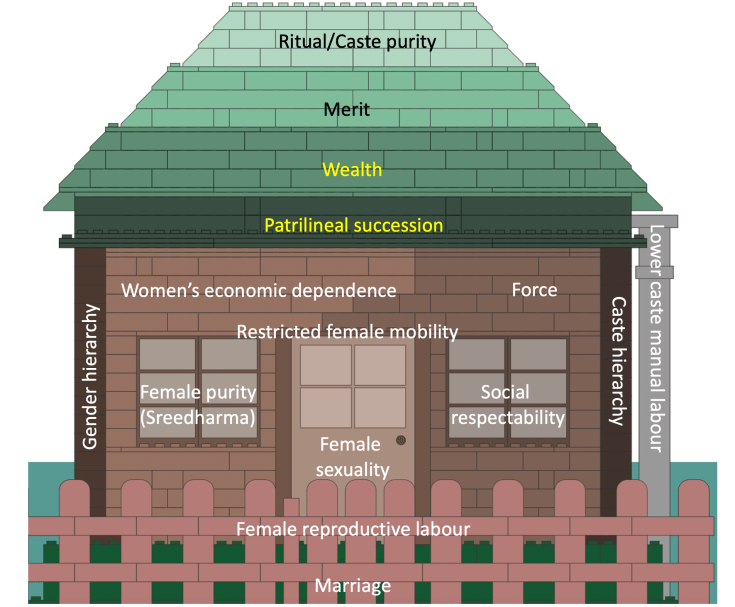
Image credit: Uma Chakravarti, Economic and Political Weekly
In many conversations, I have encountered women who paint all patriarchy with the same brush. Patriarchy has facets to it which are outrightly evil like in India the cases of girls who dared to marry out of their caste and who became victims of ‘honour’ killings. According to renowned feminist scholar Urvashi Butalia, over 60 million abortions have been carried out in India between the time it was legalised in 1971 and 2018 solely on account of the sex of the child being discovered as female. But this is different from saying patriarchy is evil.
In Indonesia and Costa Rica as well as the Indian states of Kerala and Meghalaya we find communities that are matriarchal. So, we need to understand that while patriarchy dominates, it doesn’t prevail across the board. A point that gets concealed is the role of some women themselves in preserving patriarchy. In my experience, I have encountered women supportive of patriarchy. Some feminists will say that women who support patriarchy have been shaped by systemic bias and that their support for patriarchy is itself a product of patrilineal succession. This, however, doesn’t explain why many women in India still crave to have a son as was pointed out so eloquently by Elisabeth Bumiller, former New York Times India bureau chief, in her book May You Be The Mother of a Hundred Sons.
Inequity
Equity is a human aspiration that implores acceptance, dignity and self-respect. It came into prominence during the third wave of feminism with the advent of intersectionality. The shift from the biological to the socio-cultural-psychological realm has been accentuated by two dramatic developments that relate to gender and sexual orientation with both being more or less intertwined.
“Although people still use sex and gender interchangeably, they aren’t so“
The gender discourse is currently the most topical and visible branch of feminism. Although people still use sex and gender interchangeably, they are not so. When we move to the domain of gender, we learn that it is a spectrum. For instance, Facebook offers subscribers a choice of 58 gender options, a far cry from the era when gender was treated as binary. Today, gender fluid is recognised as a non-fixed gender identity that shifts over time. A person who is gender fluid may identify as male one day, female the next, both male and female, or neither depending on circumstances. What is perceived as male or female is subjective but the gender discourse relies on a range of symbolic activities such as dressing style, consumption patterns, body movements and verbal mannerisms while making distinctions.

Image Credit: Harvard Health Publishing, Getty Images
Although the gender discourse uses the rainbow as its logo it is only symbolic. To understand the gender spectrum fully, let’s use the illustration of an artist who has just two colours to paint a canvas but is given the liberty to create different shades of each colour and also create a blend. In reality, the number of shades at the disposal of the artist is infinite. So is the case with the unfurling gender story notwithstanding that gender attributes get classified for the sake of ease.. The plurality one sees in the gender spectrum are all different derivatives and temporal combinations of the feminine and masculine.
Image Credit: Canva Stock
While intersectionality helped transform feminist movements and reduced discrimination, gender fluidity raises a fresh set of challenges. Whether it is the prohibition of use of single-sex bathrooms by transgender women, as we saw recently in the legislation introduced by US Congress representative Nancy Mace, or participation in gender segregated activities like sports, our social systems are grossly unprepared to deal with the complexity that these trends have generated.
The fourth wave of feminism theory proclaims that there are no binaries in gender. A move to migrate to gender neutral pronouns such as from ‘he’ or ‘she’ to ‘they’ is thus gaining ground. Intersectionality needs to imbibe universal values applicable not just to human gender but all species. This is the idea behind the rise of ‘ecofeminism.’ It should be noted that it isn’t by accident that we insert the prefix ‘mother’ when we say Mother Nature.
Another pronounced characteristic of contemporary feminism is its emphasis on sexuality and sexual orientation. To be clear, sexuality is the quality or state of being sexual while sexual orientation is the pattern of erotic, romantic, or sexual attraction that a person feels toward another person in relation to the gender or genders to which they are sexually attracted. The current wave of feminism has opened the floodgates of sexual orientation to people who may belong to the same sex or different sexes or may identify with one or more gender categories. This is typically referred to as LGBTQIA ++, where the I stands for Intersex, the A for Asexual and the ++ for Pansexual and Two Spirit.
For anyone who is not cisgender-heterosexual, equity is a critical human right. In this sphere there has been progress but work remains to be done. For instance, according to UNAIDS, barring 64 countries all nations have decriminalised gay sex. In India, the fact that a right-wing government undertook the passage of legislation to decriminalise gay and lesbian sex is a pointer to the collective realisation of the futility of legislation that treats homosexuality as a penal offence.
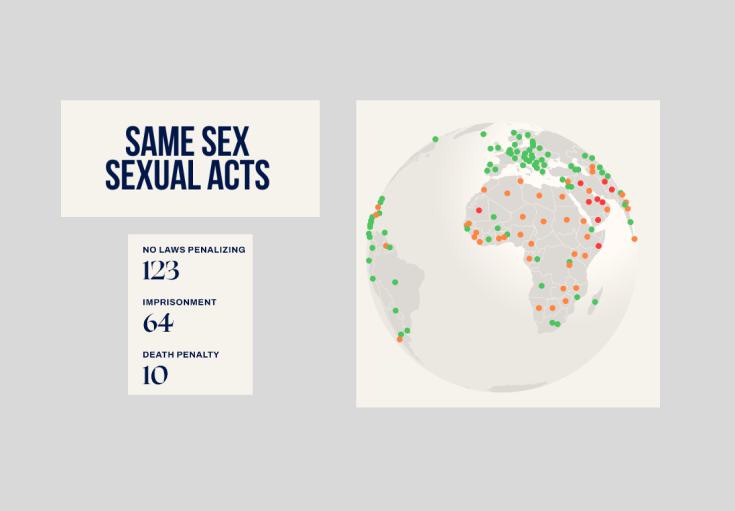
Image Credit: UNAIDS
While the imperative for equity remains, we mustn’t lose sight that equity in the context of feminist movements is not without blind spots. First, although intersectionality is a profound and brilliant articulation by Kimberlé Crenshaw and meant to undo all hierarchies of oppression, in conservative circles it is being understood as a struggle to invert the hierarchy of oppression. Second, does the emphasis on sexual orientation tell us anything about how evolved a person might be? Whether this person is loving or caring or whether this person’s ego is strong or weak? Although sexuality is vital and legitimate isn’t there so much more to life beyond sex?
Sexual Harassment
In 2017, the #MeToo hashtag surfaced to provide solidarity to women who were victims of sexual violence. It provided women with a safety net and as a consequence, many affected women started pouring out their tales of harassment. Skeletons hidden in the cupboard for years and decades started breaking out as women overcame their inhibitions to come out in the open.
Why is it that an overwhelming majority of sexual violence is carried out by men on women? Does this mean that women are devoid of urges? Not quite. What men fail to understand is that women are way more relationship driven than men. Not just this, but women are inclined to cling to guardrails before engaging in sex. Naturally, because the consequences of any sexual misdemeanour or accident have a far greater physical and emotional impact on a woman than a man. This asymmetry in understanding, accompanied by male perversion and the fact that women are naturally less violent is a root cause of rape and domestic violence.
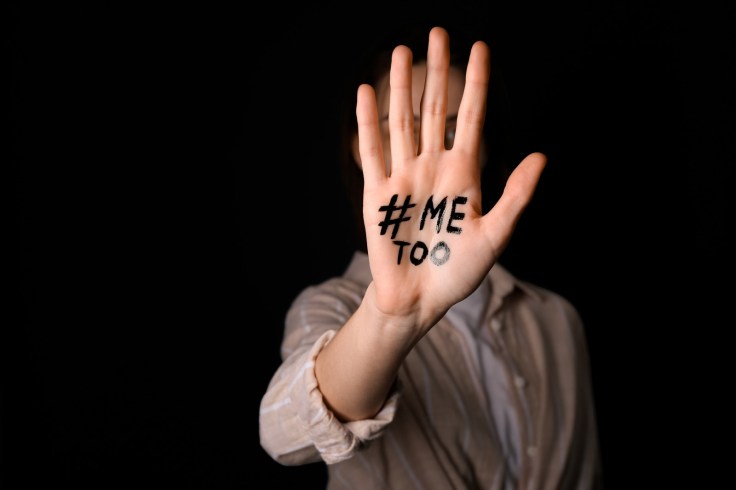
Image Credit: Canva Stock
The limitation of #MeToo, however, is that it serves as a linear, single-minded approach to naming and shaming aggressors. While it helps dealing with the symptoms of male aggression, it doesn’t go beyond that. Linear approaches do not address the root causes of lust, greed, domination, and fear. #MeToo in this sense hasn’t transformed the mindset of errant men. Only a non-linear approach sourced from universal values can help. What we need are safe spaces where sensitive and transformative conversations can be held within a safety net. The sheer absence of safe spaces cannot be replaced by any magnitude of knowledge and artificial intelligence.
“What we need are safe spaces where sensitive and transformative conversations can be held within a safety net“
Further, what complicates the #MeToo story is when some women themselves oppose it because it distorts relationships between men and women. A case in point is the open letter that French actress Catherine Deneuve along with 99 other women published in Le Monde denouncing the movement.
An understanding of the systems of oppression is essential but it doesn’t reveal what gives rise to them in the first place? What are these root causes and how can they be addressed?
To read Part III of this series, Transcendence and The Quest for Unity please click here
*****
*****
Shakti Saran is a systems thinker, writer, consultant, and the Founder of Shaktify, an initiative to power changemakers
Shakti would like to thank Dr Hélène Liu, Paramita Banerjee, and Sudarshan Rodriguez, for their reviews and precious feedback. He does not claim that any of the three would necessarily endorse everything that is presented in these essays.
Feature Image Credit: Canva Stock
Discover more from Shakti's Musings: Blogs on everything under the sun
Subscribe to get the latest posts sent to your email.
 Shakti's Musings: Blogs on everything under the sun