
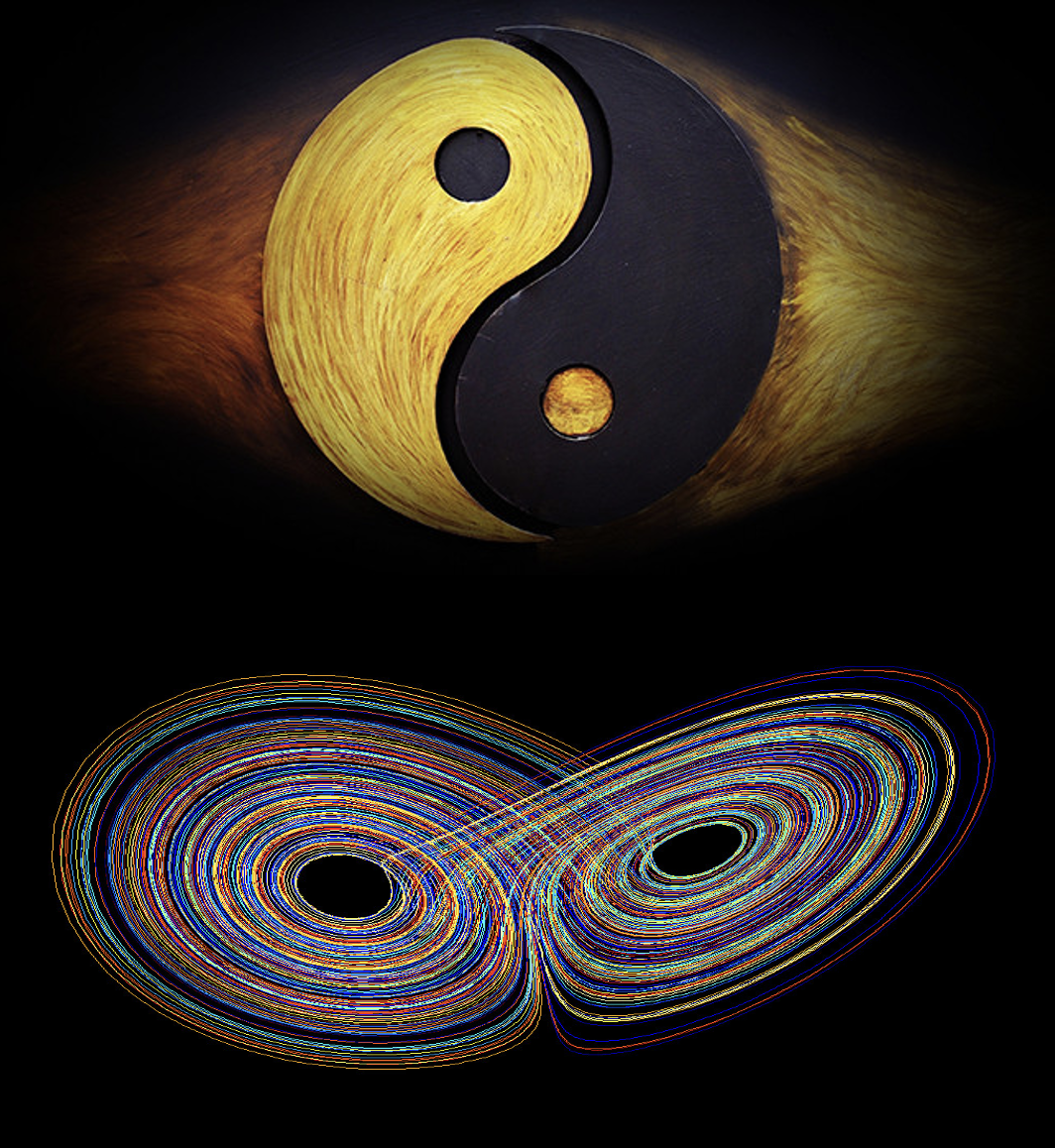
Rudyard Kipling, the British-India born English novelist and poet famously said, “East is East, and West is West, and never the twain shall meet.” I lived with this half-truth for much of my life sometimes observing the deep fault lines between Eastern and Western thought and on other occasions experiencing their undercurrents that tend to embrace and repel each other.
Quite providentially, I recently stumbled upon an essay, Karma and Chaos, written by Paul R Fleischman, M.D. and his son Forrest Fleischman. In this piece, the authors build an intellectual bridge between the realities of the West and the East while one of them relies heavily on the experiential dimension of life. When I read it, I was astonished at their amazing clarity and sense of synthesis. For me it was an out-of-the-blue appearance like manna from heaven.
In this blog piece, I have attempted to convey the essence of their essay.
The shortcomings of Western linear science
Think of a game of billiards that consists of three balls one of which is used for striking. When a ball strikes another, it is possible to map the velocity and direction of the ball being struck depending on every angle and force that is used whilst striking. This is classical western science for you which owes its genesis to the works of Galileo Galilei, Rene Descartes and Isaac Newton.
The challenge with this billiard table analogy of Western linear science is that it is based on an artificial frame which simply does not mirror our amorphous, boundless, ever-expanding universe. Linear science was borne from a desire to control nature and is mired in our thirst for certainty. Its progress lay in its study of inanimate, non-living systems to the exclusion of sentient beings. Coming back to our billiard table analogy, linear science assumes that the striking ball strikes only one and not two balls and that ball struck remains within the bounds of the billiard table. But what if the striking ball struck more than one ball and what if the ball that was struck was done so with such force that it fell off the table? Linear science presumes such scenarios don’t exist. What’s more, linear science does not attempt unearthing the intentions of the striker since the striker has supposedly no role.
In the 19thcentury, pioneering studies in evolutionary biology carried out by Charles Darwin laid the foundations for systems science that were to branch out differently from linear science but would remain dwarfed in comparison with the rapid strides linear science was to make. It was not till the late ‘70s and ‘80s when a breakthrough that led to the discovery and formulation of chaos theory did Western science assume a more holistic view of nature and life.
Simplifying the Juxtaposition
Systems science is the study of the interrelationships between all inanimate things, phenomena, organisms, species, ideas, networks and institutions. It offers great hope because of its universal embrace. When a TV journalist asked Peter Senge, the renowned systems thinker from MIT, to explain systems thinking, he responded saying “it is the ability to see the consequences of my own actions.” Now, anyone who has had a brush with Eastern thought will tell you that the Sanskrit word karma, refers to the long chain of causes and effects of one’s own actions. So, are there parallels between these two phenomena?
A limitation of the larger body of systems thinking is that it knocks on the door of the self; opens the door; satisfies itself with the view but doesn’t quite enter. On the other hand, the challenge with Eastern philosophy is that it may point to the physical, external universe but doesn’t really take you there. This means that so long as there is a chasm between the two, life remains fractured.
Chaos theory is modern science’s attempt to explain the world we live in beyond fixed, artificial boundaries. In the last five decades or so it has found increasing applications in turbulence, weather, ecology, economics and even human behaviour. Chaos theory is the product of initial work carried out by meteorologist Edward Lorenz who attempted making sense of random data for weather and ended up discovering and formulating non-linear equations.
Dr Fleischman and Forrest explore how chaos theory lends a clear understanding of karma. Western science is so grounded in cause and effect such that anything not ruled by cause-and-effect would-be considered as superstition or mumbo jumbo. Although the larger body of systems science attempts to shift the causal fabric from a narrow, linear view to a broader spectrum, yet some of it is predicated on ‘luck’. Does this sound surprising or false? The authors explain that the science of genetics suggests it to be a matter of fate because it lies outside our volition. In other words, while our lives are governed by the power to make choices our birth does not follow these laws and the consequences of our actions — for the individual self — cease at death because Western science does not recognise there is a ‘before’ or ‘after’.
Western psychology attributes personality traits to our genes whereas the Buddha explained our birth traits to be derived from chaos and events in previous lives. The view that our genes, which are outside our choice, shape us is a denial of causality which Western science so famously pursues otherwise.
Understanding Chaos Theory.
Chaos theory can be best understood by what is referred to as the Butterfly Effect which in simple language is the straw that breaks the camel’s back or minor variations that cause grossly disproportionate effects. Chaos theory is the product of non-linearity and an infinite view.
Our physical world is broken up into zones of rules which are technically referred to as attractors. For example, the Earth’s temperature zone is the region to which the Earth’s atmosphere is attracted. If the Earth’s atmosphere is sufficiently disturbed it may migrate to a different attractor which may result in very different planetary behaviour. The whole study of climate change and the warning cries are about the possible jump of Earth from one attractor to another. It is our embedded linear thinking that prevents us from recognising such behaviour because any change at the margin is seen sans context and dismissed as non-worrisome.
A key takeaway from chaos theory is that in the short term a system may appear without any pattern but over longer periods it reflects general patterns. These longer periods may extend before and beyond our lives and not restricted to one basin of time.
Karma and Chaos
Karma is the description of the origins of our personality and the causal mechanism underlying rebirth. In a recent encounter with Satish Kumar, author, educationist and former monk, he told a gathering that “we have been around since the Big-bang.” Although Western science has probed the origins of the universe and evolutionary biology has helped us understand how we got here, the role of the self has been largely excluded.
According to Indian philosophy, our body or the skin of self is a temporary membrane in a constantly changing universe. The body-mind is neither the origin nor the end of what it manifests. This Earth, this universe is one temporary shape of space within vaster cycles of order and change. While there is no enduring self — meaning we are all connected and are a microcosm of the universe — we do have individuality and carry unique history.
It is inconceivable therefore, that the consequences of our actions — for the individual self — are only at play between the time of our birth and death. When we measure effects, we typically do at one or several points of time. But the true impact of our actions may extend beyond the time period of our measurement.
Karma means that our actions occur in a dynamic world that resembles an endless billiard table with hundreds of balls upon it already whizzing along its surface in multiple directions. The fate of our ball hinges not only upon its own force and direction but also from other balls it may collide
Karma is neither freedom nor determinism but a dynamic fusion of both. Chaos theory points to a world view in which opposites can be seen to act in concert. The universe is always a marriage between opposites and our psyches our driven by this atomic complex synthesis of free choice and lawful consequence; between freedom and limits; finite and infinite, determinacy and non-determinacy, form and formlessness and order and chaos.
Developing an Integrated Worldview
Chaos theory and karma help us understand that we cannot predict the outcomes of our choices but their fusion helps us in becoming increasingly foresighted about the consequences of our actions. The greatest adaptability is found at the edge of chaos. The Buddha’s teachings emphasised striking this balance and seeking the middle ground: a space between repetition and uniqueness, stillness and observation and focus and unbiased receptivity.
The unique contribution of the Buddha was that he saw karma primarily as mental actions, i.e., the source from which all other actions arise. Karma properly understood can kindle both acceptance and optimism. But as the authors rightly point out conceptual thinking can only help in inspiring right action. Eventually it is our meditation and moral compass that will help us save our selves and not our mathematics and philosophy.
Shakti Saran is a systems thinker, writer, consultant, and the Founder of Shaktify, an initiative to power changemakers
Feature image credits: Art of Living, Irfan Bashir (Project Nile)
Author’s note: The essay Karma and Chaos is the final essay in a book containing eight essays written by Dr Paul Fleischman that bears the title. These essays are of appeal to anyone who meditates. If you are a meditator in any Buddhist tradition, these should resonate further but this book is of heightened relevance for anyone who has experienced Vipassana meditation. The final essay, Karma and Chaos, is a joint effort between Dr Fleischman and Forrest and strictly speaking, is meditation-neutral. A copy of the eBook Karma and Chaos can be procured here.
Discover more from Shakti's Musings: Blogs on everything under the sun
Subscribe to get the latest posts sent to your email.
 Shakti's Musings: Blogs on everything under the sun
Leave a comment