
The biggest challenge in contemporary life today is a crisis of perception. What makes our planet and humanity what it is for better or worse? If you ask a motley group of people this question, chances are that you would encounter major dissonance.
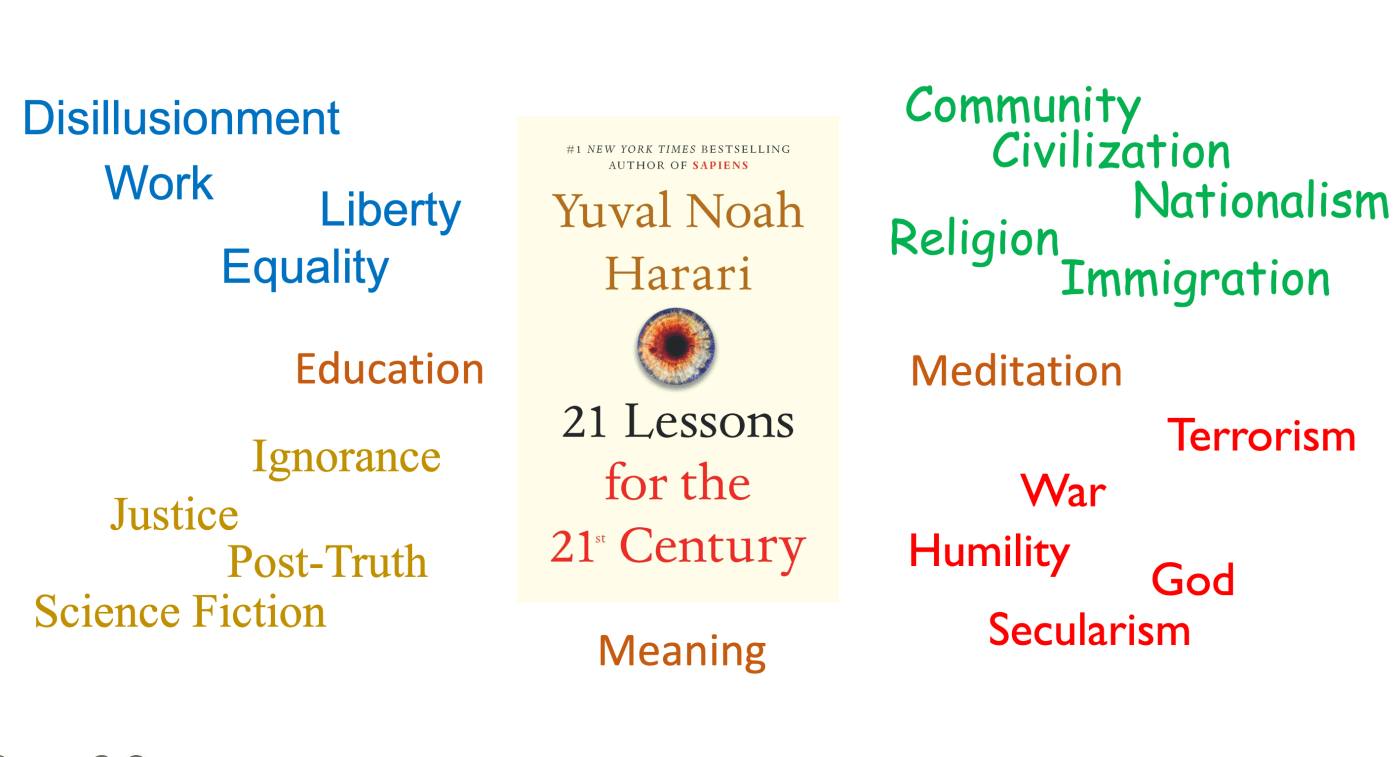
Historian Yuval Noah Harari, in his book 21 Lessons for the 21st Century offers an understanding of contemporary global reality. After mapping the history of mankind in ‘Sapiens – A Brief History of Humankind’ and ‘Homo Deus – A History of Tomorrow’, Harari lands his readers into the here and now. And in doing so, he stitches an insight-laden narrative that drills a tunnel in search of light and freedom from despair.
Essentially, this book is a collection of twenty-one essays, grouped across five themes and threaded to kindle a debate aimed at uncovering and overcoming our political, religious, cultural and gender biases. For those suffer from time poverty, this book is an affordable deep-dive into the world of liberal arts and the author takes you through a medley of genres covering history, philosophy, science, economics, politics, psychology, evolutionary biology, anthropology, sociology and more.
The starting point of this narrative is the struggle to save the endangered world of liberal democracy from the sinister worlds of fascism and communism. The author chooses to hand over the thread – at the end of each chapter – to start his next chapter. But this book can be read in either a linear or a non-linear way. I personally, chose to read the essays in a random order and found that I could access the essence of the whole book more easily but if you are not accustomed to thinking in systems, I recommend you stick to the sequence the author presents.
In the first part of the book, Harari portrays the unfolding technological disruptions and the scary consequences of the marriage of artificial intelligence with biotechnology. He provokes readers to wake up to the emerging reality of digital dictatorships, mass unemployment, accentuation of inequalities, the surfacing of biological castes and consequential irrelevance of human beings. He opines that “Democracy in its present form cannot survive the merger of biotech and infotech” and links ongoing technological advances to the relentless pursuit of economic growth which he sees as the epicentre of our ecological crisis.
In the second part of the book, Harari dwells on the political challenges of our times; the limitations of nationalism and the role of universal values. He writes “Nationalism is not a natural and eternal part of the human psyche, and it is not rooted in human biology.” The problem with supremacy is that it comes sans obligations to anyone else. According to him, global challenges such as climate change worsen with nationalist isolationism. If the playground for our economics and our science is global then he questions why should our politics remain narrow and not global?
In the third part of the book, Harari shifts the landscape to the alternating cycle of despair and hope. He demonstrates amazing clarity depicting the roots of terrorism and offers ‘humility’ as a potential remedy for natural stupidity. He juxtaposes challenges like terrorism and religious fanaticism with domestic and sexual violence and questions why governments take one challenge way more seriously than another. In response to the competition between religions that claim they are the centre of the universe, he writes, “None of the religions or nations today existed when humans colonised the world. Morality, art, spirituality and creativity are universal human abilities embedded in our DNA.”
As the book progresses, the reality shifts from external to internal; from societal to individual. In the fourth part of the book, he builds a case for systems thinking. He inquires, “In a world where everything is interconnected, the supreme moral imperative becomes the imperative to know…today, we need to take into account all viewpoints. Yet, how can anyone understand the web of relations between thousands of intersecting groups across the world?” He then goes on to share different methods people use to fulfil their quest for this understanding
The last part of the book lands the reader to what seems to be the ultimate aim of this book. The upheavals and disruptions of our times require significant mental adaptability and stocks of emotional balance which he says cannot be acquired by reading a book or listening to a lecture. The search for peace and joy can be arrived at by ensuring our identities are loose and can be merged at will with the cosmos. The quest for meaning; the essence of contemporary education; the exploration for one’s own true-self are presented as segways to end individual and societal suffering.
The book is remarkable in two ways. First, the author despite being a Jew by birth, doesn’t hesitate to assume a self-deprecating stand. He criticises the lack of peace between Israelis and Palestinians because of the former’s unwillingness to divide the city of Jerusalem citing the belief that it is the eternal capital of the Jewish people. He questions whether a city that was established 5000 years ago can qualify being termed eternal against the backdrop of our planet which is 4-5 billion years old.
The book is also a repository of incredible quotes and profound insights. Consider this for example, “If by ‘free will’ you mean the freedom to do (or not do) what you desire- then yes, humans have free will. But if by ‘free will’ you mean the freedom to choose what to desire- then no, humans have no free will.” And the book is replete with one-liners like this one, “If you can really observe yourself for the duration of a single breath-you will understand it all.”
This book has its limitations despite its enormous strength. It is short on the economic and ecological challenges that are staring at us, for instance the unchecked use of fossil fuels. Harari doesn’t even have all the answers but this was never meant to be a book of solutions. Instead, he offers a way, a path that helps us sharpen the clarity of our perception. As the opening sentence of his book says it so magnificently, “In a world deluged by irrelevant information, clarity is power.”
Shakti Saran is a systems thinker, writer, consultant, and the Founder of Shaktify, an initiative to power changemakers
Discover more from Shakti's Musings: Blogs on everything under the sun
Subscribe to get the latest posts sent to your email.
 Shakti's Musings: Blogs on everything under the sun
Leave a comment